
You’ve Said Yes to a Colombia mission trip. What Happens Next?
You’ve read about mission trips. You’ve thought about volunteering. Maybe you’ve even wondered whether you have the experience, time, or courage to say yes.
But what actually happens when you arrive in Colombia and spend a week serving with The Emiliani Project?
Every mission trip is different. The needs of the children and Hogar de Cristo help shape each team’s activities, so there isn’t a single itinerary that every volunteer follows. What remains consistent is the purpose: serving children, supporting the home, building relationships, and putting faith into action.
Here’s a glimpse of what a week serving with The Emiliani Project can look like.
Arriving in Colombia and Leaving the Routine Behind
Hogar de Cristo is located in Caldas, approximately 30 minutes south of Medellín. The home sits in the mountains at roughly 7,000 feet, surrounded by views of the Colombian countryside. The Emiliani Project describes the setting as an opportunity to unplug from everyday life and immerse yourself in missionary work.
That change in environment is significant.
Phones, meetings, deadlines and daily routines begin to lose some of their importance. In their place are new relationships, unfamiliar surroundings and a shared purpose.
Volunteers stay at Hogar de Cristo itself, where accommodations, meals and transportation during the mission are provided. Meals are generally shared at the home, often eating the same food as the children.
Before traveling, volunteers can prepare with our guide, What to Pack for a Mission Trip to Colombia (and What You Don’t Need).
Meeting the Children Changes the Trip
The work matters, but the relationships often become what volunteers remember most.
Hogar de Cristo officially opened in July 2023 after approximately a decade of prayer, fundraising, construction and volunteer involvement. Today, the organization’s website reports that 27 children are living at the home.
Volunteers aren’t simply arriving at a worksite.
They’re entering the children’s home.
That distinction should be at the heart of this article.
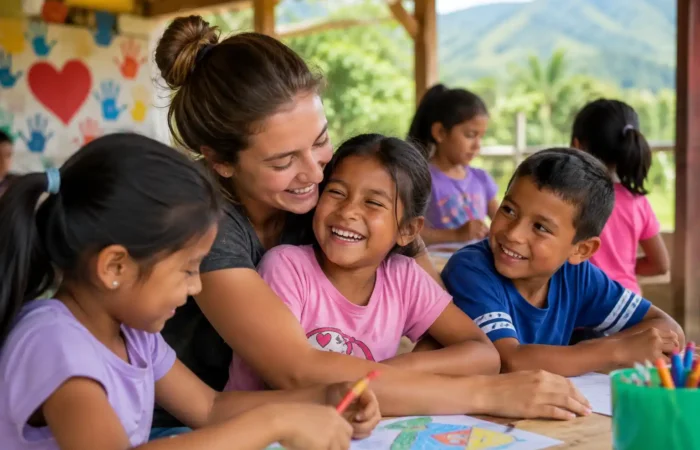
Time might be spent talking, playing games, sharing meals, participating in activities or simply being present with the children. Previous Emiliani trips have included everything from Christmas celebrations and group games to painting, maintenance projects and building a playground.
This is where I’d use several of the best photographs from the recent trip. Rather than making the photos decorative, we can allow them to advance the story.
What Does a Volunteer Actually Do?
This is where I’d be careful until we get Bryan’s input about the most recent trip.
The Emiliani site confirms that mission teams may help with construction, classrooms, dormitories, bathrooms, repairs and other light construction, as well as working directly with the children.
But a prospective volunteer may picture something much more intimidating than the reality.
You don’t necessarily need construction expertise. You don’t need to be a teacher. You don’t need years of mission experience.
We’ve addressed that question more fully in Do You Need Experience for a Mission Trip? What to Expect Serving in Colombia.
Sometimes what you bring is simply a willingness to help wherever you’re needed.
The Moments You Don’t Put on an Itinerary
This could be my favorite section.
A mission trip may have a schedule, but relationships don’t.
Some of the most memorable moments can happen between the scheduled activities: sitting around a table, laughing with a child, sharing a meal, helping with a project or having a conversation that neither person expected.
Previous Emiliani volunteers repeatedly describe this reversal.
Alex Narelli said that by the end of his trip, it seemed the children had given the volunteers more than they could have provided them. Edris Olomi similarly described arriving with the intention of making a difference and discovering how deeply the children and staff changed him. Father Andrew Gillies, who has brought groups from Canada for years, describes receiving from the children and staff far more than the volunteers could give.
We’ve explored that side of mission work more deeply in What Volunteers Discover: How Serving in Colombia Changes More Than the Children.
Faith Becomes Action
This needs to be more than a quick Bible verse near the end.
The faith connection is central to why The Emiliani Project exists.
The organization takes its name from Saint Jerome Emiliani, a former soldier who ultimately dedicated his life to caring for children orphaned by war. The founders of The Emiliani Project are also U.S. military veterans, and the organization describes their own journeys as including periods of struggle and distance from faith before developing a shared commitment to serving children.
A mission trip provides an opportunity to live that faith rather than simply talk about it.
Jesus’ teaching in Matthew 25 comes alive in a different way when service becomes personal.
You learn names.
You share meals.
You work alongside others.
You listen.
You laugh.
You pray.
And gradually, “loving your neighbor” becomes less of an abstract Christian principle and more about the person standing directly in front of you.
And Then It’s Time to Go Home
This is where I’d connect the article emotionally back to the opening.
A week eventually ends.
Suitcases are repacked. Volunteers say goodbye. Flights leave Colombia and everyday routines begin again.
But many volunteers discover that something comes home with them.
The relationships do.
The perspective does.
And sometimes the desire to return does too.
A Colombia mission trip with The Emiliani Project isn’t a vacation. In fact, the organization’s FAQ explicitly makes that distinction. It is an opportunity to step away from your normal routine and spend a week intentionally serving others.
And sometimes, somewhere along the way, the person who came to help discovers that God was also doing something in them.
Could Your Week Be Next?
The Emiliani Project currently lists upcoming mission trips for November 11–18, 2026, July 10–18, 2027, and November 10–17, 2027. The current requested contribution is $750 per person, which covers lodging, food, transportation and planned activities in Colombia; airfare is separate.
You don’t have to know exactly what you’ll do when you arrive.
You simply have to be willing to take the first step.
Explore upcoming Colombia mission trips and learn how to volunteer